Are you ready for your annual check ups?
The major shutdown season is fast approaching. Are your isolation valves leak-free? Will lockout procedures be completed on time, or will an internal leak impact the progress of your work and the safety of your workers? Do your valves need to be refurbished or replaced? Will supply chain delays affect your planned work? All these questions arise, but the solution is simple! Ultrasonic inspection of isolation valves.
Ultrasonic inspection of isolation valves
Leak testing of isolation valves is crucial in many industries, such as the petrochemical, food, and pharmaceutical sectors, among others. Defective or leaking valves can lead to product loss, production interruptions, delays in scheduled shutdowns, and even risks to operator safety and the environment. That is why regular valve monitoring is essential for maintaining smooth and safe operations.
How is the inspection conducted?
When inspecting a valve, the technician uses an ultrasonic tool to measure the sound level in decibels on the pipeline upstream and downstream of the valve in question. This method, commonly known as A-B-C-D, requires a pressure differential between the upstream and downstream sides of the valve.
In addition, ultrasonic tools offer a non-destructive method for inspecting valves, meaning there is no need to disassemble, damage, or take them out of service during the inspection. This allows companies to maintain continuous production while ensuring the safety and quality of their operations.
The Ultrasonic Phenomenon
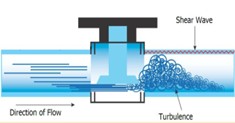
By applying higher pressure on one side of the valve, we aim to create turbulence that generates ultrasonic waves. The sounds produced are outside the range of human hearing but can be detected and measured using an ultrasonic detection device. When the valve is closed, if the valve seat or valve element (disc, blade, ball, etc.) shows signs of wear, the flow will not be laminar and smooth, and it is this turbulence that allows us to diagnose problematic valves.
Case study: significant cost savings through ultrasonic detection
At a fuel transfer station that receives diesel and various grades of gasoline by rail, the railcars are unloaded using a pump; the pump’s outlet feeds various buffer tanks, from which tanker trucks are filled for distribution to gas stations in the region.
The pump has two suction lines, each isolated by a set of valves and actuators. One for gasoline, one for diesel and the outlet is equipped with the same valve and actuator assemblies.
During routine quality control testing, operators at the transfer station found traces of diesel in the gasoline. To continue operations, the backup pump was used; this pump has its own valve and actuator system but has a lower capacity, causing delays in operations.
The strategy implemented was to replace the four valve and actuator assemblies; each assembly costs $85,000, and the issue was that only three assemblies were available for the planned shutdown in July, while the others had a 16-week lead time. Given the situation, a “Plan B” was necessary. The client then contacted us to explore the possibilities, and a plan of action was put in place, followed by an ultrasonic inspection.
The pump has two suction lines, each isolated by a set of valves and actuators. One for gasoline, one for diesel and the outlet is equipped with the same valve and actuator assemblies.
During routine quality control testing, operators at the transfer station found traces of diesel in the gasoline. To continue operations, the backup pump was used; this pump has its own valve and actuator system but has a lower capacity, causing delays in operations.
The strategy implemented was to replace the four valve and actuator assemblies; each assembly costs $85,000, and the issue was that only three assemblies were available for the planned shutdown in July, while the others had a 16-week lead time. Given the situation, a “Plan B” was necessary. The client then contacted us to explore the possibilities, and a plan of action was put in place, followed by an ultrasonic inspection.
170 000$
Cost savings on the client's budget
as a result of our plan.
as a result of our plan.
Measurable Impact
Only two valves showed signs of internal leaks, allowing us to prioritize the work, and the customer saved $170,000 on their budget. Furthermore, since the two faulty valves were identified, the main pump can continue to operate on gasoline alone (since the diesel valves are sealed, there is no longer any risk of contamination), and operations are significantly less impacted.